Three Outside Up Candlestick Pattern
A three outside up is a three-candle bullish reversal in which a large green candle engulfs a small red candle at the end of a decline, and a third green candle then closes above the engulfing candle's close, showing buyers kept control for a second session.
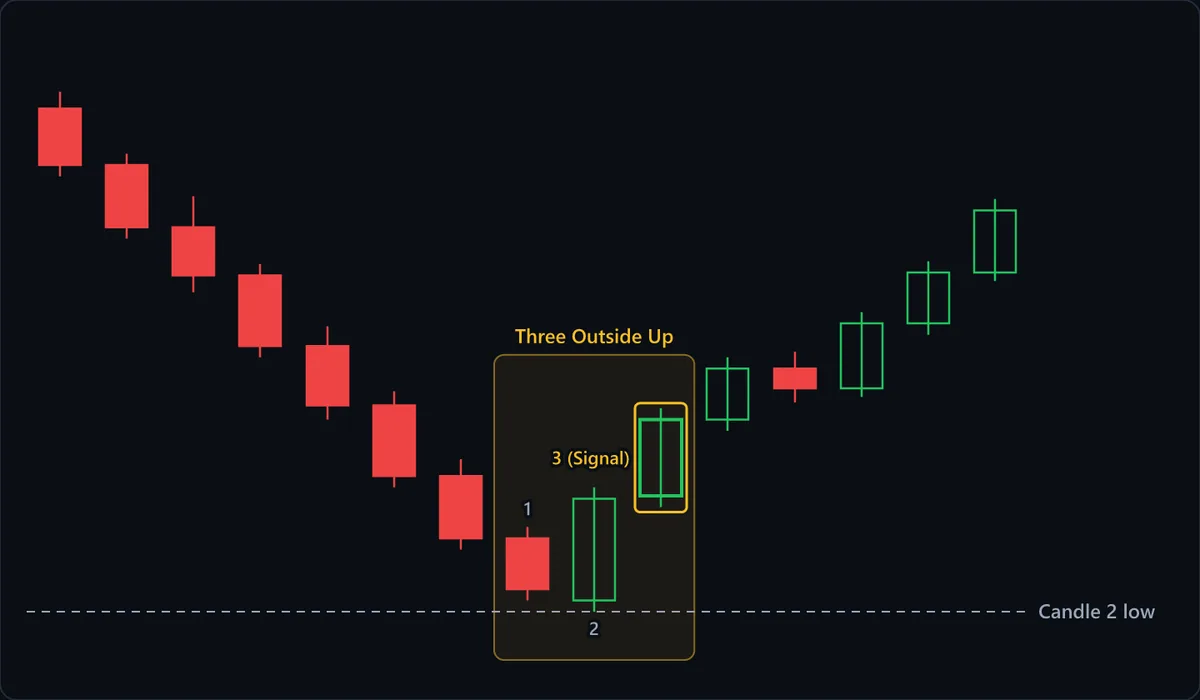
Chart data
| # | Open | High | Low | Close |
|---|---|---|---|---|
| 1 | 120 | 120.6 | 117.6 | 118 |
| 2 | 118 | 118.4 | 115.4 | 115.8 |
| 3 | 115.8 | 116.9 | 113.5 | 114.1 |
| 4 | 114.1 | 114.5 | 111.2 | 111.6 |
| 5 | 111.6 | 112.3 | 109 | 109.5 |
| 6 | 109.5 | 110 | 106.6 | 107 |
| 7 | 107 | 107.6 | 104.4 | 104.8 |
| 8 | 104.8 | 105.2 | 102.6 | 103 |
| 9 | 102.6 | 106.6 | 102.2 | 106.2 |
| 10 | 106.3 | 109.4 | 105.9 | 109 |
| 11 | 109 | 111.2 | 108.6 | 110.8 |
| 12 | 110.8 | 111.4 | 109.6 | 110.1 |
| 13 | 110.1 | 112.8 | 109.8 | 112.4 |
| 14 | 112.4 | 114.6 | 112 | 114.2 |
| 15 | 114.2 | 116.8 | 113.9 | 116.4 |
At a glance
| Type | Bullish reversal |
|---|---|
| Direction | Bullish |
| Bars required | 3 candles |
| Family | Candlestick pattern |
| Evidence | Moderate |
| Also called | three outside up candlestick, 3 outside up, three outside up pattern |
What timeframe does it work on?
It reads best on daily charts, where candle 3 is a separate session and proves buyers came back after the engulfing day. On 1- to 5-minute charts, all three candles can belong to a single burst of short covering, so the third candle confirms nothing new. In markets that trade around the clock, candle 2 usually opens level with candle 1's close instead of below it; that still counts if its body covers candle 1's.
Anatomy of the pattern
- Prior decline — The seven red candles leading into the highlighted box. Without that selling there is nothing to reverse, and the same three candles inside a flat range are just a dip and a bounce.
- 1: the small red candle — A modest red candle that extends the decline by one more lower close. The smaller it is next to candle 2, the more decisive the takeover looks.
- 2: the engulfing candle — Green, opening below candle 1's close and closing above candle 1's open. Here it also clears candle 1's high and low, covering the wicks as well as the body, which is the stricter version. Candles 1 and 2 on their own are a bullish engulfing.
- 3 (Signal) — A second green candle that closes above candle 2's close. This is what separates the pattern from a plain engulfing: the session after the takeover did not give the gain back. The pattern is only complete when this candle closes.
- Candle 2 low — The dashed line at the engulfing candle's low, here the deepest point of the turn and the price buyers first defended. The stop goes below it, and a close beneath it erases the reversal.
How to identify it
- Price has been falling into the pattern, and candle 1 adds one more red candle to that decline.
- Candle 2 is green, opens at or below candle 1's close and closes above candle 1's open, so its body fully covers candle 1's body.
- Candle 3 is green and closes clearly above candle 2's close; a close that edges past by a sliver is weak follow-through.
- Candle 3 may be long or gap up and the pattern still counts, but an extended third candle puts the entry far from candle 2's low; see Entry.
- Ideally candle 2's low sits on prior support or an earlier swing low, a level buyers have defended before.
How to trade it
Entry. Buy at candle 3's close or on a shallow dip right after it. With a lone bullish engulfing you wait for the next candle to confirm; here candle 3 is that confirmation, so its close is already the patient entry. If candle 3 ran far above candle 2, wait for a dip that holds above candle 2's close rather than chase the extended bar.
Stop. Below candle 2's low, the level marked on the chart. That low is where buyers began taking the market back, so a close under it means the reversal has failed. Because the entry comes a candle later than with a lone engulfing, the stop spans both green candles and is usually wide; shrink the position to fit it rather than moving the stop under candle 3, a level the pattern gives no reason to defend.
Target. The pattern projects no distance. Aim at the nearest overhead resistance, often the last lower high inside the decline, and take the trade only if that level sits at least twice the stop distance above the entry. The later entry makes that two-to-one test harder to pass than it is for a plain engulfing.
What invalidates it
- Price closes below candle 2's low. The level where buyers took over is gone, and so is the premise of the trade.
- Candle 3 closes red, or at or below candle 2's close. That is an engulfing whose follow-through failed, exactly the outcome the third candle exists to rule out.
- Candle 2 does not close above candle 1's open. Without full coverage of candle 1's body there is no engulfing, and a higher third close cannot turn it into a three outside up.
- There was no decline into it. In a range or an uptrend the same three candles are ordinary buying, with no selling to reverse.
Often confused with
Three Outside Up vs Bullish Engulfing: what's the difference?
Candles 1 and 2 of a three outside up are a bullish engulfing, so the third candle is the whole difference. An engulfing is complete at its second candle and still awaits confirmation; a three outside up exists only once a third green candle closes above the engulfing candle's close.
Three Outside Up vs Morning Star: what's the difference?
Both are three-candle bottoms, but the big candles sit in different places. A morning star runs long red, small stalled middle, long green recovery; a three outside up runs small red, large green engulfing, then a third green candle that only has to close higher.
Three Outside Up vs Three Inside Up: what's the difference?
Look at the middle candle. In a three outside up it is large and wraps a small red first candle; in a three inside up it is small and sits inside a large red candle's body, a harami. Small then big is outside; big then small is inside.
Three Outside Up vs Three White Soldiers: what's the difference?
Three outside up starts with a red candle that the second, green candle fully engulfs, so that second candle opens below the red body's close and closes above its open; a third green candle then closes higher. Soldiers never engulf; each opens inside the previous green body and simply closes higher.
How reliable is the three outside up pattern?
The three outside up is a bullish engulfing with its confirmation built in: the third candle filters out the engulfings that fail immediately, at the cost of a later entry and a wider stop. That keeps it in the moderate tier rather than higher. Results also shift with the definition used: body-only or full-range engulfing, a third close above candle 2's close or above its high, and how the prior decline is measured. Bulkowski catalogs and tests it, but no single success rate survives those choices.
References
- Thomas N. Bulkowski. Encyclopedia of Candlestick Charts . Wiley , 2008 . ISBN 978-0470182017.
Frequently asked questions
What does a three outside up mean?
Is a three outside up bullish or bearish?
How do you trade a three outside up?
Does a three outside up need confirmation?
How reliable is the three outside up?
Practise spotting the three outside up
Reading about a pattern is not the same as recognising it under time pressure. Chart Guess drills 53 patterns as a 60-second game — read the chart, call BUY or SELL, get the pattern name instantly.