Three Outside Down Candlestick Pattern
A three outside down is a three-candle bearish reversal in which a large red candle engulfs a smaller green candle at the end of a rally, and a third red candle then closes below the engulfing candle's close, showing sellers held control for a second session.
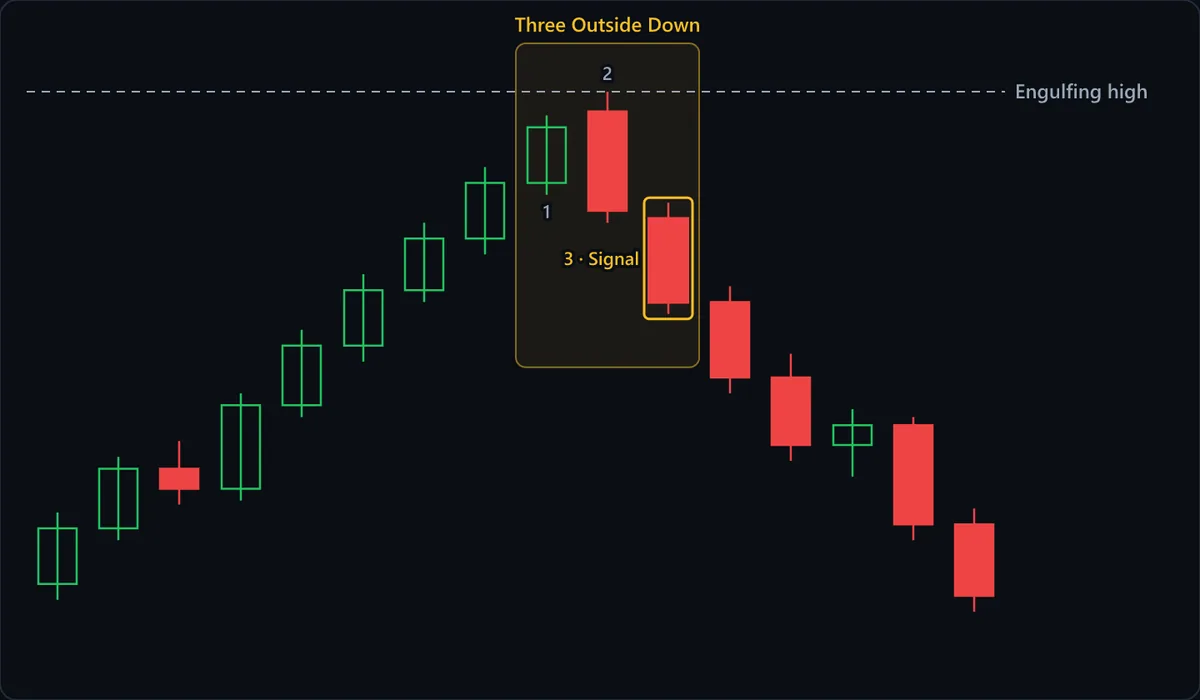
Chart data
| # | Open | High | Low | Close |
|---|---|---|---|---|
| 1 | 99.8 | 101.6 | 99.4 | 101.2 |
| 2 | 101.2 | 103 | 100.9 | 102.7 |
| 3 | 102.7 | 103.4 | 101.8 | 102.2 |
| 4 | 102.2 | 104.6 | 101.9 | 104.3 |
| 5 | 104.3 | 106.2 | 104 | 105.8 |
| 6 | 105.8 | 107.6 | 105.4 | 107.2 |
| 7 | 107.2 | 108.9 | 106.9 | 108.5 |
| 8 | 108.5 | 110.3 | 108.1 | 109.9 |
| 9 | 109.9 | 111.6 | 109.6 | 111.3 |
| 10 | 111.7 | 112.2 | 108.9 | 109.2 |
| 11 | 109 | 109.4 | 106.6 | 106.9 |
| 12 | 106.9 | 107.3 | 104.6 | 105 |
| 13 | 105 | 105.6 | 102.9 | 103.3 |
| 14 | 103.3 | 104.2 | 102.5 | 103.8 |
| 15 | 103.8 | 104 | 100.9 | 101.3 |
| 16 | 101.3 | 101.7 | 99.1 | 99.5 |
At a glance
| Type | Bearish reversal |
|---|---|
| Direction | Bearish |
| Bars required | 3 candles |
| Family | Candlestick pattern |
| Evidence | Moderate |
| Also called | three outside down candlestick, 3 outside down, three outside down pattern, three outside down candle |
What timeframe does it work on?
Daily charts give it the most weight: candle 3 is a separate session in which buyers had a full night to return and did not. On one-minute charts all three candles can be one liquidation flush, so the third red bar adds no independent evidence. Crypto and forex rarely gap, so candle 2 often opens flat with candle 1's close; judge it by whether its body still covers candle 1's body.
Anatomy of the pattern
- Prior rally — The run of rising candles into the highlighted box. The pattern only means something as the end of an advance; mid-range, the same three bars are a pop and a drop with nothing to reverse.
- 1: the green candle — One more higher close in the rally. The smaller it is next to candle 2, the more lopsided the takeover; two candles of similar size make a much weaker engulfing.
- 2: the engulfing candle — Red, opening at or above candle 1's close and closing below candle 1's open. In this chart it opens above candle 1's high and closes under its low, so it engulfs the wicks too. Candles 1 and 2 alone are a bearish engulfing; the pattern is not finished yet.
- 3 · Signal — A second red candle closing below candle 2's close, turning a one-day engulfing into two days of sellers in charge. Nothing is tradable until it closes, since a bounce inside it would still cancel the pattern.
- Engulfing high — The dashed line at candle 2's high, the last price buyers reached before the turn. It is the reference for the stop: a close back above it means the whole rejection has been bought back.
How to identify it
- Price has been rising into the pattern, and candle 1 is a green candle that extends that rise.
- Candle 2 is red, opens at or above candle 1's close and closes below candle 1's open, so its body covers all of candle 1's body.
- Candle 3 is red and closes below candle 2's close. A close only a tick or two lower technically qualifies but adds little confirmation.
- Skip it if candle 3 has already fallen a long way. A huge third body or a gap down leaves the entry far below the engulfing high.
- Stronger when candle 2's high probes a level that has capped price before, such as a prior swing high or a resistance zone.
- Skip it if there is no room below: the nearest support is sitting just under candle 3's close.
How to trade it
Entry. Sell at candle 3's close, or on a small bounce right after it that stalls below candle 2's close. Candle 3 already does the job a confirmation bar does for a lone engulfing, so waiting for a fourth red candle mostly gives away price. If candle 3 is stretched, prefer the bounce: shorting a long red bar straight into support is the classic way this setup goes wrong.
Stop. Above the high of candle 2, the engulfing high on the chart. That is the top of the rejection; a close above it means buyers have reclaimed everything sellers took. The stop covers both red candles and is wide for a candlestick setup, so shrink the position to fit it rather than tucking the stop above candle 3, a level the pattern gives no reason to trust.
Target. The candles project no distance, so the target comes from the chart: the nearest support below, often the rally's last higher low. Short only if that level is at least twice the stop distance away. The entry is a full candle lower than with a plain engulfing, so this test fails more often, and failing it is a reason to pass.
What invalidates it
- Price closes above candle 2's high. The top that sellers rejected has been reclaimed, so the reversal premise is gone.
- Candle 3 closes green, or at or above candle 2's close. The engulfing got no follow-through, which is exactly the case this pattern was meant to screen out.
- Candle 2's body does not reach below candle 1's open. Without full body coverage it is at best a dark cloud cover, and a third red candle does not turn it into a three outside down.
- There was no rally beforehand. In a downtrend the same candles are just more selling, with no top to mark.
Often confused with
Three Outside Down vs Bearish Engulfing: what's the difference?
The first two candles of a three outside down are a bearish engulfing, so only candle 3 separates them. The engulfing is complete after two bars and still waits for confirmation; the three outside down does not exist until a third red candle closes below candle 2's close.
Three Outside Down vs Evening Star: what's the difference?
Both are three-candle tops, but the middle candle differs. An evening star's middle is a small stalled body at the top between a long green and a long red; a three outside down's middle is the biggest candle of the three and does the reversing itself.
Three Outside Down vs Three Black Crows: what's the difference?
Count the colors. Three black crows needs three consecutive red candles, each closing lower. A three outside down starts with a green candle, and its second candle is a single large engulfing bar rather than one of three similar steps.
Three Outside Down vs Three Inside Down: what's the difference?
Look at the middle candle. In a three inside down it is small and fits inside the green body, so the third candle does the reversing. In a three outside down it is a large red candle that engulfs the green body, so the reversal is made before the third candle arrives.
How reliable is the three outside down pattern?
The three outside down is a bearish engulfing with the confirmation candle built into its definition, and the standard candlestick references treat it that way. The third candle screens out engulfings that are bought back at once, at the cost of a later entry and a stop spanning two red candles. That keeps it in the moderate tier, alongside the engulfing it grows from, not above it. Bulkowski catalogs and tests it, but results shift with the rules chosen: body-only or full-range engulfing, a third close below candle 2's close or its low, and how the prior rally is measured. No single success rate survives those choices.
References
- Thomas N. Bulkowski. Encyclopedia of Candlestick Charts . Wiley , 2008 . ISBN 978-0470182017.
Frequently asked questions
What does a three outside down mean?
Is a three outside down bullish or bearish?
How do you trade a three outside down?
Does a three outside down need confirmation?
What happens after a three outside down?
Practise spotting the three outside down
Reading about a pattern is not the same as recognising it under time pressure. Chart Guess drills 53 patterns as a 60-second game — read the chart, call BUY or SELL, get the pattern name instantly.