Bull Flag Pattern: Spot It, Trade It
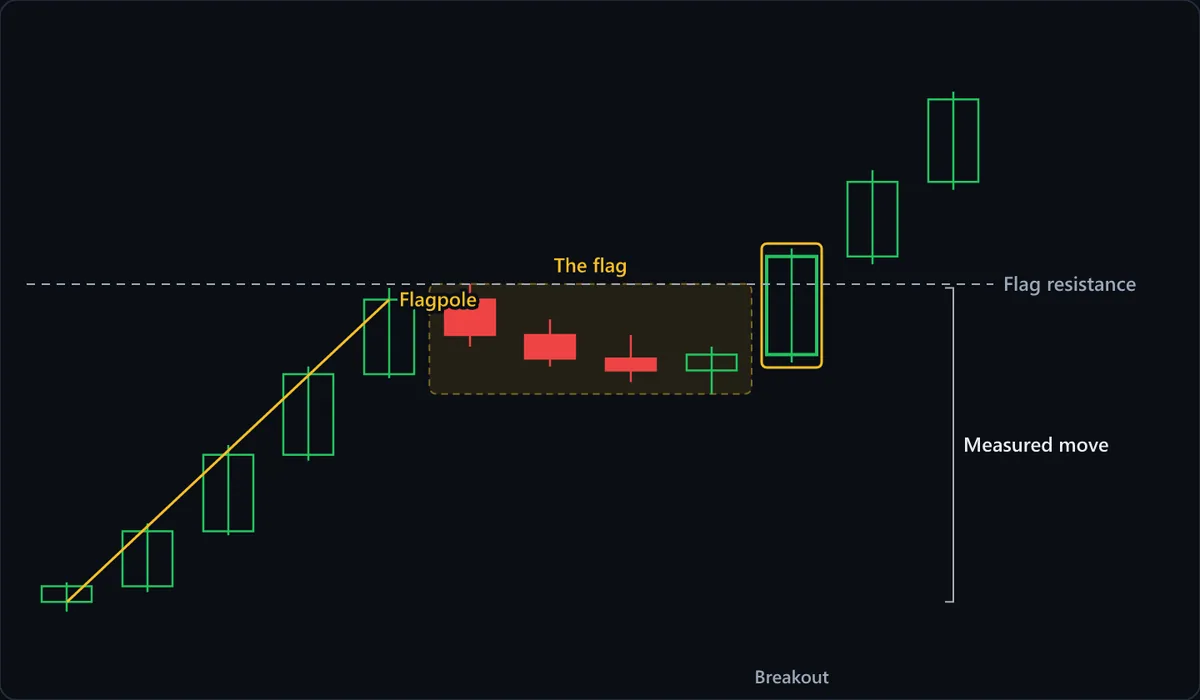
Chart data
| # | Open | High | Low | Close |
|---|---|---|---|---|
| 1 | 100 | 101 | 99.5 | 100.8 |
| 2 | 100.8 | 104 | 100.5 | 103.6 |
| 3 | 103.6 | 108 | 103.4 | 107.5 |
| 4 | 107.5 | 112 | 107.2 | 111.6 |
| 5 | 111.6 | 116 | 111.4 | 115.4 |
| 6 | 115.4 | 116.2 | 113 | 113.6 |
| 7 | 113.6 | 114.4 | 112 | 112.4 |
| 8 | 112.4 | 113.6 | 111.2 | 111.8 |
| 9 | 111.8 | 113 | 110.6 | 112.6 |
| 10 | 112.6 | 118 | 112.2 | 117.6 |
| 11 | 117.6 | 122 | 117.2 | 121.4 |
| 12 | 121.4 | 126 | 121 | 125.6 |
The bull flag is a continuation pattern: a sharp rally, a brief orderly pause, then a resumption of the uptrend. It's a favorite of momentum traders because it's frequent, visually clear, and gives a defined entry and target. Here's how to identify it and the traps to avoid.
The anatomy: pole, flag, breakout
- The flagpole — a strong, near-vertical price advance on rising volume. This is the momentum move.
- The flag — a tight, orderly consolidation that drifts slightly down or sideways, usually on falling volume. This is profit-taking, not reversal.
- The breakout — price breaks above the flag's upper boundary, ideally on a volume surge, and the uptrend resumes.
Identification checklist
- A clear, strong prior up-move (the pole).
- A pullback that's shallow and controlled — a flag, not a collapse. If it retraces more than about half the pole, it's probably not a flag.
- The flag slopes gently down or sideways, contained between two roughly parallel lines.
- Volume declines through the flag.
- A breakout above the flag on increased volume confirms it.
How to trade a bull flag
- Entry: on the breakout above the flag's upper trendline, ideally with a volume spike. Conservative traders wait for a candle to close above.
- Stop: below the flag's low — if price falls back into the flag, the setup has failed.
- Target: a common approach is to project the height of the flagpole upward from the breakout point.
Always size the position so a stop-out is a small, survivable loss. The pattern is a probability, not a promise.
Bull flag vs bear flag
They're mirror images:
| Bull flag | Bear flag | |
|---|---|---|
| Prior move | Sharp rally up | Sharp drop down |
| Flag direction | Drifts down / sideways | Drifts up / sideways |
| Breakout | Upward (continuation) | Downward (continuation) |
| Bias | Bullish | Bearish |
Common fake-outs and mistakes
- No real pole. A flag without a strong prior move is just chop — the pattern needs momentum behind it.
- Deep pullback. If the "flag" retraces most of the pole, the trend is likely reversing, not pausing.
- Rising volume in the flag. That suggests genuine selling, not a healthy pause.
- Chasing before the breakout. Entering inside the flag exposes you to a failed setup with no confirmation.
The only way to stop confusing a bull flag with a random pullback is to see hundreds of both — labeled — until the difference is obvious at a glance.
Drill the bull flag until it's obvious
Chart Guess shows you realistic setups — including bull flags, bear flags and their fake-outs — and names each one after you call it. On iOS and Android.